
Sign up for our free webinar Visualize it: The Secret of High-Performing Teams

Sign up for free webinar

Blog — learning

152 Results for: learning

You could always add curved connectors to draw.io, but we’ve made it easier now to add extra curves and waypoints.

Curved connectors in draw.io diagrams

Sometimes, diagrams call for a bit more creativity and fun - you can now add even more curves to your curved connectors in draw.io diagrams! You could always add curved connectors to draw.io, but we've made it easier now to add extra curves and waypoints.…

By Kymberly Fergusson |

Using the draw.io text plugin, you can extract the text directly from any flowchart, diagram, or even infographic.

Extract text with the draw.io text plugin

Have you ever wanted to explain a flowchart of a business process in words? For example, perhaps you wanted to send an email to your team explaining how to perform a new process. Of course, you'll link to your draw.io flowchart in your email, but what do you…

By draw.io Engineering |

How to create flowcharts in draw.io

How to create flowcharts in draw.io

Flowchart use cases Flowcharts, data flow diagrams, workflows, process diagrams, activity diagrams, process maps: No matter what you call them, you have most likely used them! Flowcharts are the most common diagram type that is used in all industries and…

By Kymberly Fergusson |

UML diagrams - which diagram to use and why

UML diagrams - which diagram to use and why

The Unified Modeling Language (UML) is a diagramming notation (language) that lets you visualize systems and software. It's one of the most popular forms of diagramming in software development and became an ISO standard in 1997. Since then, there have been a…

By Kymberly Fergusson |

There are several different line styles that you can use for your connectors in draw.io.

Connector styles and animations in draw.io

Lines, connectors, arrows, transitions - these are the glue that hold diagrams together. They make your diagram make sense. There are many different styles you can use on your connectors - different connection point styles or arrow heads, different line…

By Kymberly Fergusson |

UML state diagrams with draw.io

UML state diagrams with draw.io

State diagrams have been used in programming to describe the various possible states that a system can be in for decades. They also quickly show which states lead to each other, and what triggers a change of state. Of course, you can use these diagrams for…

By Kymberly Fergusson |

You can attach draw.io diagrams directly to the issues where they belong by using the draw.io app for Jira.

Add a draw.io diagram to a Jira issue

Many companies use Jira for task management: software development teams, business management, marketing teams, help desks, you name it - all departments can take advantage of Jira's powerful features to coordinate their projects. You can attach draw.io…

By Kymberly Fergusson |

You can create UML interaction overview diagrams in draw.io. These UML diagrams are a combination of an activity diagram and sequence diagrams.

UML interaction overview diagrams in draw.io

You can create all types of UML diagrams in draw.io, as you have seen in previous posts. So far, we've covered use case diagrams, activity diagrams, class diagrams, and sequence diagrams. In this post, let's take a look at interaction overview diagrams.…

By Kymberly Fergusson |

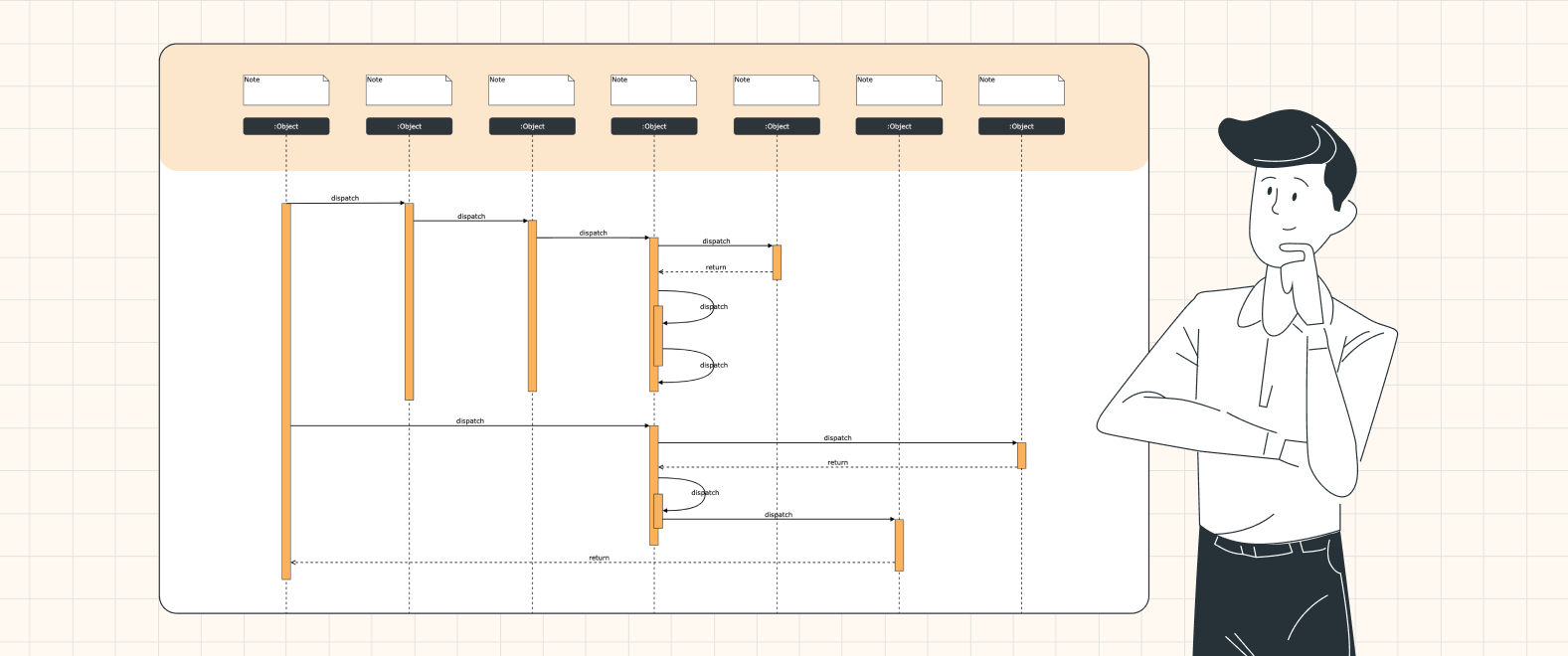
Illustration of a person studying a UML sequence diagram on a whiteboard with Note and :Object lifelines dispatching messages between them in draw.io

Create UML sequence diagrams in draw.io

UML sequence diagrams are the first highly detailed behavioural diagrams that you will create when using UML for software development. They aren't so often used in business process modelling, especially because they refer to the actual data and operation…

By Kymberly Fergusson |

Experience the power of draw.io

How would you like to explore?

draw.io Digest – Subscribe to our Newsletter

Yes, I would like to receive the draw.io for Confluence and Jira newsletters, whitepapers, the latest blog posts, and announcements. (You can unsubscribe at any time.)

For more information about our data usage, please refer to our privacy policy.

Here you will find an overview of all cookies used. You can give your consent to whole categories or display further information and select certain cookies.